
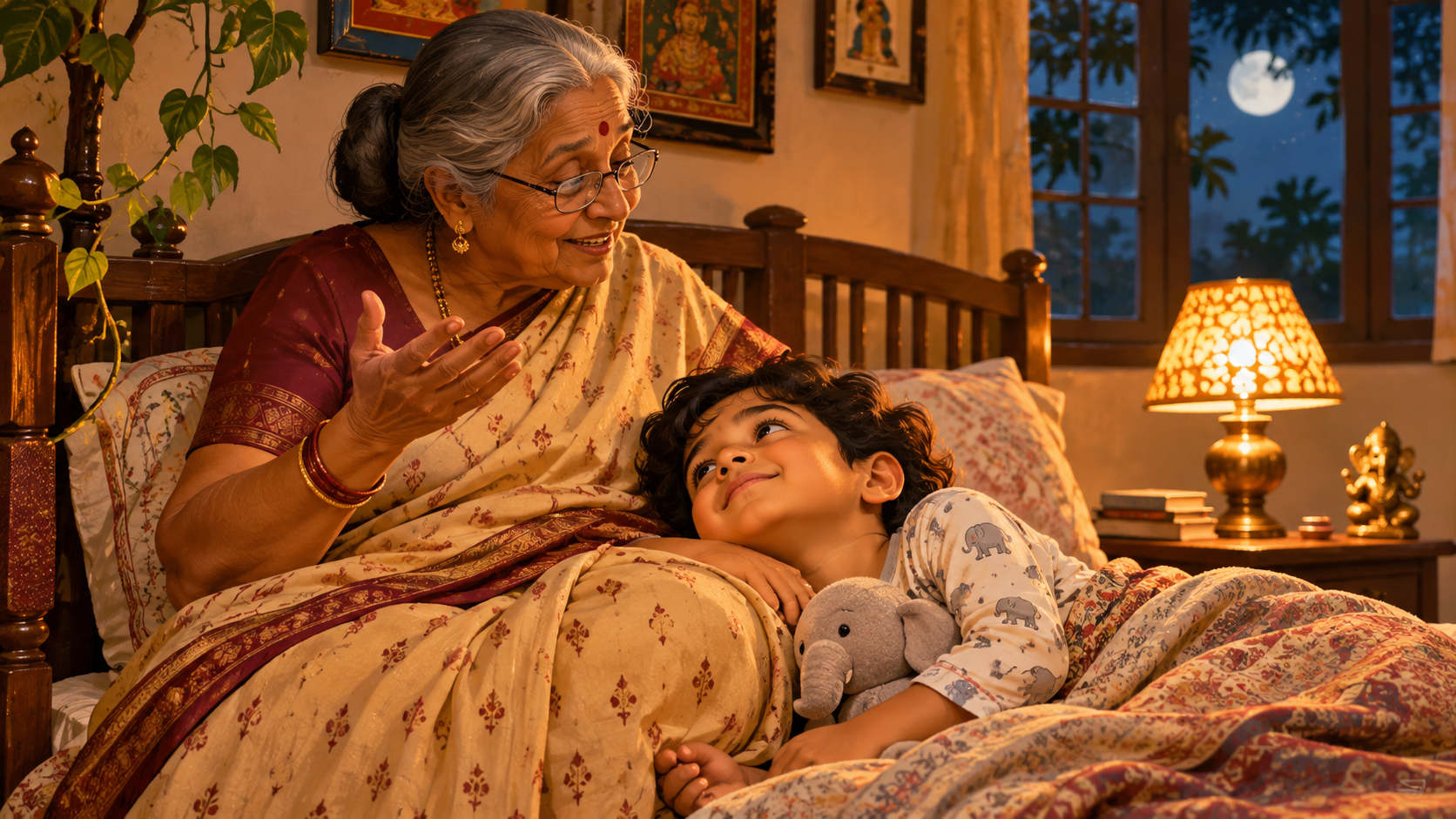
Benefits of Bedtime Stories for Children: Rediscovering the Joy of Childhood
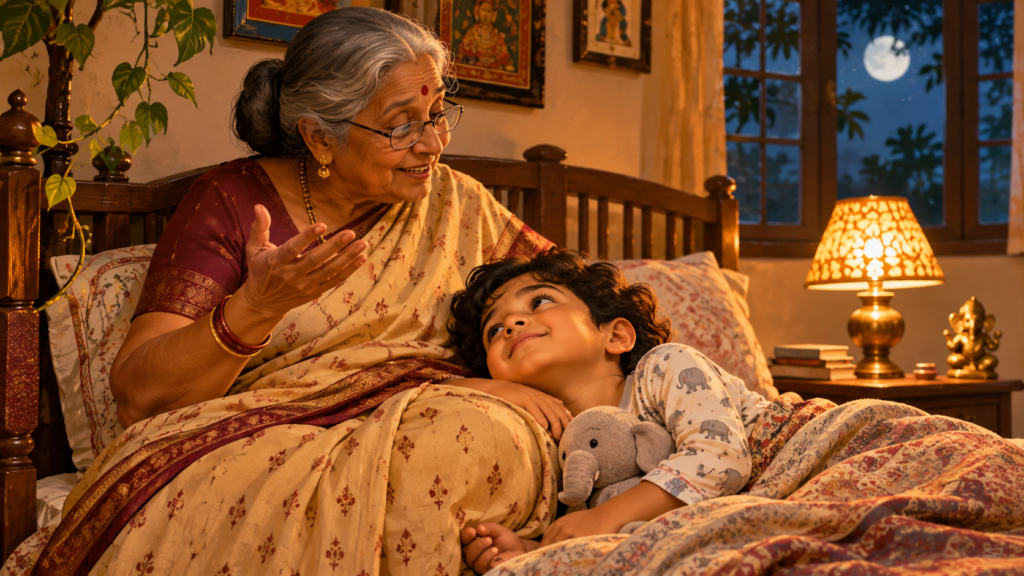
Do you remember the time when you would lie beside your grandmother, eagerly waiting for her to tell you a bedtime story?
There were no smartphones or tablets then. No animated videos to keep us entertained in bed. All we wanted was someone to say, “Once upon a time…”
As the story unfolded, we created an entire world in our minds. Mighty kings. Magical forests. Talking animals. Powerful gods. We laughed. We felt frightened. We asked questions. And sometimes, we even fell asleep before the story ended, wondering what would happen next.
Little did we realise then that the benefits of bedtime stories for children extended far beyond entertainment. Those simple storytelling sessions were helping shape our imagination, language skills, values and love for reading.
Table of Contents
Key Takeaways
- Bedtime stories support children’s language development, imagination and emotional understanding.
- Storytelling strengthens relationships between children, parents and grandparents.
- Regular shared reading can encourage a lifelong love for books.
- Traditional Indian stories help preserve cultural heritage across generations.
- Just 10 to 15 minutes of storytelling every day can create meaningful family moments.
- Technology can complement traditional storytelling rather than replace personal interaction.
What Are the Benefits of Bedtime Stories for Children?
The benefits of bedtime stories for children include improved language skills, vocabulary development, imagination, emotional understanding and stronger family bonds. Regular storytelling can also encourage reading habits, introduce children to cultural traditions and create a comforting bedtime routine.
What Does Scientific Research Say About the Benefits of Bedtime Stories for Children?
Scientific research highlights several developmental benefits of shared reading and listening to stories.
| Language development: A 2020 meta-analysis published in Child Development, covering 19 randomised controlled trials and 2,594 children, found that shared picture-book reading supported expressive and receptive language development. |
| Imagination: A 2015 study published in Pediatrics found an association between home reading exposure and brain activity related to mental imagery and story comprehension. |
| Emotional development: The American Academy of Pediatrics recommends shared reading from infancy to support cognitive, linguistic and social-emotional development. |
Our grandparents didn’t think of this as a child development activity. They probably knew little about the scientific research on the importance of storytelling in child development. For them, this was simply a part of their everyday lives. It was their way of spending precious time with their grandchildren.
And we loved every bit of it.
How Bedtime Stories Shaped Our Childhood
Many of the stories we were told came with a moral attached. Without even realising it, we imbibed values that went a long way in shaping our lives.
We learnt about kindness, honesty, courage, gratitude and compassion. We understood why certain actions were right and others were wrong. Stories helped us understand the consequences of our choices without making us feel as though we were being taught a lesson.
We learnt to respect our elders, listen to others and express our thoughts. Conversations with relatives, neighbours and friends were a natural part of our everyday lives.
And above all, we let our imagination run free.
As we grew older, these storytelling sessions became rarer. We got busy with our studies and assignments. But we never forgot those stories.
Whenever we wanted to relive those moments, we turned to books — Chandamama, Amar Chitra Katha, Tinkle, Champak and superhero comics.
Reading those books brought back the same excitement we experienced while listening to stories from our grandparents.
Perhaps that was how many of us developed a lifelong love for reading.
Childhood Then vs Now: How Much Has Changed?
| Aspect | Childhood in earlier generations | Childhood in the digital age |
| Storytelling | Oral stories from grandparents | Digital stories, videos and audiobooks |
| Entertainment | Books and traditional games | Apps, streaming and video games |
| Imagination | Creating mental images through stories | Access to ready-made visual experiences |
| Family bonding | In-person storytelling and conversations | In-person and digitally mediated interactions |
| Learning | Books, teachers and family members | Online and offline learning resources |
| Bedtime routines | Stories and family conversations | Traditional routines alongside digital entertainment |
Can you believe that many of us grew up in an era without the internet, mobile phones or even a television in our homes?
Our parents, grandparents and teachers were our encyclopaedias. Much of what we learnt came from the people around us.
We listened. We observed. We asked questions. We absorbed knowledge from everyday experiences. And as our curiosity grew, we turned to books to find answers.
Vacation time was book time for many of us.
We would flock to our neighbourhood libraries and spend hours searching for books by authors we adored. Once we found them, we would read like crazy. Sometimes, we would finish 300 to 400 pages in a single day.
Without even realising it, we were enriching our vocabulary, improving our language skills and discovering the different cultures of the world.
Books took us to places we had never visited. They introduced us to people we had never met. They helped us experience emotions and situations beyond our own little worlds.
And for many of us, the foundation of this reading habit was laid by those simple bedtime stories our grandparents told us.
Are today’s children missing out on those moments?
Why Are Bedtime Stories Important for Child Development?
Today, children have access to a wealth of information and entertainment. They can watch animated stories, listen to audiobooks and explore different parts of the world without stepping outside their homes.
Technology has opened up wonderful opportunities for learning. But can it replace the experience of sitting beside a loved one and listening to a story?
The benefits of bedtime stories for children extend far beyond entertainment.
They encourage imagination. When children listen to a story without being shown every detail, they create their own versions of the characters, places and events in their minds.
They support language development. Listening to stories and reading aloud introduces children to new words, expressions and sentence structures in meaningful contexts.
They help children understand emotions. Through fictional characters, children explore feelings such as happiness, fear, sadness, anger and empathy.
They strengthen family bonds. Storytelling gives children an opportunity to spend uninterrupted time with their parents and grandparents.
They encourage reading habits. Children who associate stories and books with enjoyable experiences may be more inclined to explore books independently as they grow older.
They preserve cultural heritage. Indian mythology stories, folktales and traditional moral stories help introduce children to their cultural roots, customs and values.
A bedtime story may last only 15 minutes. But the conversations, memories and connections it creates can last a lifetime.
Are We Giving Our Children Enough Time to Simply Be Children?
Today’s children often have busy schedules. School, homework, tuition, extracurricular activities and digital entertainment compete for their attention.
Even their leisure time can become structured.
But childhood should also have room for unhurried conversations, silly questions, laughter, curiosity and imagination.
Do you remember how peaceful it felt to fall asleep listening to your grandmother’s voice?
There was no assignment to complete. No competition to win. No expectation to perform. We didn’t have to remember the story for a test the following morning.
We were simply enjoying the moment.
Earlier generations had their own challenges, and not every childhood was carefree. But these small moments of comfort and connection are worth preserving.
Perhaps we can give today’s children a little more of that joy.
A Special Message to Today’s Grandparents
If you are a grandparent today, think back to your own childhood.
Do you remember the stories your grandparents told you? The excitement of hearing your favourite story for the tenth time? The warmth of sitting beside them? The disappointment when they said it was time to sleep?
Wouldn’t you want your grandchildren to experience that same happiness?
You have something precious to offer them — a lifetime of experiences, memories, stories and wisdom that no smartphone or tablet can replicate.
Tell them about your childhood. Tell them about the games you played, the festivals you celebrated, the friends you had and the little adventures you experienced.
Tell them stories from the Ramayana, Mahabharata, Puranas and Panchatantra. Share the folktales you heard from your own grandparents.
You don’t have to be a professional storyteller. You don’t need elaborate illustrations, sound effects or animated characters.
Your voice, your expressions and your presence are what make the experience special.
Even if your grandchildren live far away, you can tell them a story over a video call. You could even record your favourite childhood stories and send them a little audio message every evening.
Imagine your grandchild growing up and remembering your voice, just as you remember your grandmother’s.
Wouldn’t that be a beautiful legacy to leave behind?
8 Simple Ways to Bring Back the Bedtime Storytelling Tradition
Parents and grandparents don’t need to make drastic changes to their daily routines. Here are a few simple ways to introduce children to the joy of storytelling and reading.
1. Set Aside 15 Minutes Every Day
Make storytelling a regular part of your child’s bedtime routine. Put your phone aside, sit comfortably with your child and give them your undivided attention.
2. Let Grandparents Become Storytellers
Encourage grandparents to share stories from their childhood. These don’t always have to be mythological stories. Personal experiences, family memories and local folktales can be equally fascinating.
3. Introduce Children to Indian Mythology
Explore age-appropriate stories from the Puranas, Ramayana, Mahabharata and Panchatantra. Discuss the characters, their choices and the values reflected in their actions.
4. Let Children Ask Questions
Don’t discourage children from interrupting a story with questions. Their curiosity is part of the experience. Ask them what they think might happen next or what they would do if they were in the character’s place.
5. Encourage Children to Create Their Own Stories
Start a story and let your child finish it. Allow them to invent characters, magical creatures and imaginary worlds. Don’t worry about whether their stories make sense. Let their imagination run free.
6. Make Library Visits a Family Activity
Take your children or grandchildren to a library or bookstore. Give them enough time to explore the shelves and choose books that interest them. Let reading become something they look forward to rather than something they are forced to do.
7. Use Technology to Read Together
Technology doesn’t have to be the enemy of storytelling. Illustrated children’s ebooks and audiobooks can make stories more accessible.
Instead of leaving children to consume digital content alone, read or listen together and discuss the story. At bedtime, consider choosing a printed book or oral storytelling to reduce screen exposure before sleep.
8. Don’t Turn Every Story Into a Lesson
Not every storytelling session needs to end with a moral, a question-and-answer session or a learning activity.
Sometimes, a story can simply be a story.
Let children laugh, wonder, imagine and enjoy the experience without feeling that they are expected to learn or achieve something.
Let’s Give Our Children Memories, Not Just Entertainment
Years from now, our children may not remember every toy we bought them, every video they watched or every game they played on a tablet.
But they may remember the evenings they spent listening to our stories. The funny voices we made. The questions they asked. The stories they insisted on hearing again and again.
They may remember how safe, loved and happy they felt in those moments.
We cannot recreate our childhood exactly as it was. The world has changed, and our children will have their own unique experiences.
But we can preserve some of the beautiful things that made our childhood special.
And perhaps the next time your grandchild comes and sits beside you, instead of handing them a smartphone, you could simply smile and say,
“Come, let me tell you a story…”
As someone who grew up loving stories from Indian mythology, I wanted to introduce today’s children to the same magical world. Through illustrated children’s books written in my Pen name – Vedika Nanda, I hope to help parents and grandparents rediscover the joy of sharing traditional Indian stories with the younger generation.
Explore my collection of illustrated Indian mythology stories for children and begin your own bedtime storytelling tradition.
— Nanditha Vasudev
Frequently Asked Questions About Bedtime Stories for Children
Why are bedtime stories important for children?
Bedtime stories support language development, imagination, emotional understanding and reading habits. They also provide opportunities for children to bond with their parents and grandparents.
How long should parents read bedtime stories to their children?
Parents can start with 10 to 15 minutes of storytelling every evening. The quality and consistency of the interaction matter more than the duration.
At what age should parents start telling bedtime stories?
Parents can begin reading aloud and telling simple stories from infancy. As children grow older, they can introduce more complex stories and encourage conversations about characters and events.
How does storytelling help brain development in children?
Listening to stories engages cognitive processes associated with language comprehension, memory and mental imagery. Interactive storytelling also encourages children to ask questions, make connections and express their thoughts.
Can grandparents help with child development through storytelling?
Yes. Grandparents can support children’s language skills, emotional connections, cultural awareness and curiosity through storytelling, shared reading and meaningful conversations.
Are bedtime stories better than screen time?
Oral storytelling and shared reading offer opportunities for personal interaction and imagination that passive screen consumption may not provide. Screen-free storytelling can also form part of a calming bedtime routine.
Are Indian mythology stories good for children?
Age-appropriate Indian mythology stories can introduce children to cultural traditions and values such as kindness, courage, humility, compassion and forgiveness.
Can ebooks help children develop reading habits?
Yes. Age-appropriate illustrated ebooks can encourage an interest in reading, particularly when parents and grandparents read alongside children and discuss the stories with them.
About the Author
Nanditha Vasudev is a content writer, children’s author and storyteller who writes under the pen name Vedika Nanda. Through her illustrated children’s books, she retells timeless stories from Indian mythology, the Puranas and traditional folklore. Her work aims to cultivate reading habits, nurture imagination and help parents and grandparents pass on India’s rich storytelling heritage, cultural traditions and timeless values to younger generations.